
iRacing license classes and Safety Rating
To get out of Rookies you need 3.00 Safety Rating or higher and two official races (or four Time Trials) in eligible Rookie series. Rookie is the only class with a Fast Track at 3.00 SR, so hitting both promotes you to Class D immediately, not at season end.
Every category climbs the same six-step ladder
Section titled “Every category climbs the same six-step ladder”Every category, oval, sports car, formula, dirt oval, and dirt road, has its own license that climbs the same six steps: Rookie, Class D, C, B, A, Pro. Pro and World Championship are qualification or invite only; you race your way into a series rather than grind into them.
A license shows as a letter and a number from 0.00 to 4.99, like B 3.45. The letter is your class; the number is your standing inside that class. A brand-new account starts at SR 2.50 in Rookie, so you begin most of the way to the 3.00 you need to escape.
Higher classes unlock higher series and faster cars. Many GT3 and prototype series gate entry behind a B or A license, so the class you hold decides which cars you can race.
Safety Rating is corners per incident
Section titled “Safety Rating is corners per incident”Safety Rating measures corners per incident (CPI), which is how many corners you complete, on average, between picking up incident points. It has nothing to do with where you finish. That is iRating, a completely separate number that tracks pace and finishing position.
This is the most common mix-up on r/iRacing: drivers gaining SR but flat iRating, or the reverse, and assuming one is broken. They aren’t connected. Clean and slow lifts SR while iRating stalls. Fast and crashy does the opposite. To climb the license ladder you only need SR.
Incidents score 0x to 4x, only the highest counts
Section titled “Incidents score 0x to 4x, only the highest counts”Incident points are assigned per event by severity:
- 0x: very light contact, minor.
- 1x: off track (one or more wheels over the line / track limits).
- 2x: loss of control (a spin).
- 4x: car-to-car contact, or hitting a wall or object.
Only the highest counts. One event scores the single highest value, not the sum. Clip the wall and spin in the same moment and you take 4x, not 6x. Dirt series (Dirt Oval and Dirt Road) tend to score contact more leniently, since trading paint is part of dirt racing; check the specific series rules for how incidents are weighted.
Incident inheritance. If light 0x contact from you sends another car into a spin or crash, you can pick up a 2x or 4x of your own even though your car was barely touched.
Track limits are shifting. iRacing has been moving some track-limits corners off the incident system entirely, replacing the automatic 1x at certain apexes with an in-race “slow down” time penalty set per corner, so not every track-limits excursion costs SR anymore. Check the series rules for the corners that still count.
Session incident limit. Each session has a hard cap (commonly around 17x, but set per series). Cross it and you’re black-flagged and out of that race.
Promotion needs 3.00 SR plus your MPR
Section titled “Promotion needs 3.00 SR plus your MPR”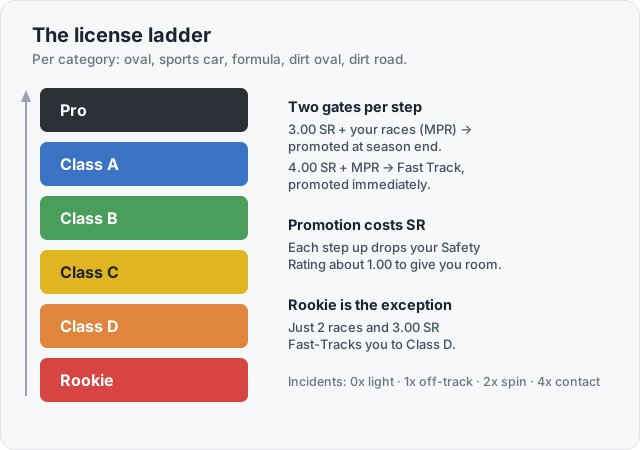
From Class D upward, reach 3.00 SR and complete your Minimum Participation Requirement, which is four ranked official races (or four ranked Time Trials) at or above your current class in that category, and you’re promoted at the end of the season.
Hit 4.00 SR with the MPR met and you get a Fast Track: an immediate mid-season promotion instead of waiting for the season to roll over.
Rookie is the exception. Its MPR is just two races (or four Time Trials), and it Fast-Tracks to Class D at 3.00 SR, so a clean Rookie is promoted the moment both conditions are met, mid-season, not at season end.
Because promotions and demotions land at season end, it pays to know when your season closes and which sessions are still running so you can finish your MPR races in time. Startlight, the iRacing schedule widget, shows what session is live now, what’s next, and time-to-green, which makes lining up those races easier.
SR drops about 1.00 on every promotion, by design
Section titled “SR drops about 1.00 on every promotion, by design”A few mechanics make SR fall even when you’re driving fine:
- Promotion reset. When you level up, SR drops about 1.00, so promote at
C 3.4and you start aroundB 2.4. That’s the “my SR dropped when I leveled up” complaint, and it’s working as intended to give you room to climb at the harder level. - Demotion thresholds. Finish a season below 2.00 and you’re demoted. Fall below 1.00 and you’re demoted immediately, mid-season. Between 2.00 and 3.00 your license is untouched; you just don’t get promoted.
- Harder math at higher classes. A 1x costs an A-class driver more SR than the same 1x costs a D driver. SR is genuinely harder to hold the higher you go.
SR carries over week to week. It only recalculates on promotion or demotion, not every season.
Recover low SR with distance, not sprints
Section titled “Recover low SR with distance, not sprints”CPI is an average, so the fastest fix is distance without incidents. Long, clean races build corners-per-incident far quicker than short sprints, where a single incident wrecks the ratio. Two SR grinds come up repeatedly for this reason, both stacking many repeatable corners with low contact risk:
- Skip Barber. A low-pressure field with slow, forgiving cars, so you turn clean corners without much traffic to collect incidents.
- Nürburgring Nordschleife. The long lap piles up corners fast, and r/iRacing names the Ring Meister series specifically because you can run it multiple times a day.
The tactical rule: take the 1x over the 4x. Running wide for a 1x off-track is cheap; refusing to lift and collecting car-to-car contact for 4x is not. Give the corner away and keep the contact off your record. Deliberately tanking your own SR or iRating is a protestable offense under the Sporting Code, so the only real lever is clean laps.
Stable hardware helps the math too. A repeatable brake point lap after lap means fewer lock-up spins, which is the 2x most newer drivers bleed SR on. See pedals if your braking is inconsistent.
Rookie has no demotion floor
Section titled “Rookie has no demotion floor”There is no demotion below Class D, and Rookie has no floor at all. You can’t lose the license you’re sitting on, which is why Rookie races are chaos: drivers with nothing to lose dive into corners they’d never risk a class up. Escaping still comes down to the same math: clear 3.00 SR with clean, longer races.
Frequently asked questions
What do I need to get out of Rookie class in iRacing?
You need 3.00 Safety Rating plus your Rookie Minimum Participation Requirement, which is 2 official races (or 4 Time Trials) in eligible Rookie series. Rookie is the only class with a Fast Track at 3.00 SR, so hitting both promotes you straight to Class D mid-season; you don't wait for the season to roll over. From Class D up, the MPR is four races and a Fast Track needs 4.00 SR.
Why did my Safety Rating drop after I got promoted?
It's working as intended. When you level up a class, SR drops about 1.00, so promote at C 3.4 and you start around B 2.4, to give you room to climb at the harder level. SR is also genuinely harder to hold higher up: the same 1x costs an A-class driver more SR than it costs a D-class driver.
What is the difference between Safety Rating and iRating?
Safety Rating measures corners per incident, which is clean driving, and is the number that promotes you up the license ladder. iRating measures finishing position against the field and gates nothing. They move independently: clean-and-slow lifts SR while iRating stalls, and fast-and-crashy does the reverse.
What is the fastest way to recover a low Safety Rating?
Distance without incidents, since SR is corners-per-incident averaged. Long, clean races build the ratio far faster than short sprints, where a single incident wrecks it. Low-pressure fields like Skip Barber and long-lap series such as the Nürburgring Nordschleife (Ring Meister) are popular SR grinds because you can turn many clean corners per session. The tactical rule: take the 1x over the 4x, giving the corner away rather than collecting car-to-car contact.
Is an endurance race actually good for Safety Rating?
Only if the field stays clean. The corner count is on your side, since SR is incidents averaged over corners turned, and hours of clean laps dilute a mistake to nothing. But a chaotic enduro full of contact can tank you just as hard, because a 4x is a 4x. The long-lap, low-traffic series win on SR; a packed sprint-style enduro is a coin flip.
Why does one mistake wreck my Safety Rating so much in a 15-minute race?
Because there are fewer corners to dilute it. SR is incidents averaged over corners turned, so a single 4x or a couple of off-tracks in a short sprint lands against a small corner count and moves the number hard. The same incident in a long race barely registers. If you're rebuilding SR, run longer events with more corners per session rather than back-to-back sprints.