
What is iRating? iRacing's skill rating, explained
iRating is iRacing’s skill rating, an Elo system borrowed from chess that starts every driver at a provisional 1350 and moves up or down based purely on where you finish relative to everyone else in your session. It is a matchmaking number, not a license. It does not gate Rookie, D, C, B, A, or Pro, which is Safety Rating’s job, and it tracks one thing: how fast you finish compared to the field.
iRating and Safety Rating move independently
Section titled “iRating and Safety Rating move independently”These are two separate numbers, and they confuse new drivers constantly. Safety Rating measures corners per incident, which is clean driving, and it is what promotes you from Rookie through D, C, B, A. The licenses and Safety Rating page owns those mechanics in full. iRating measures finishing position against the field and gates nothing. You can sit at 1.5k iRating with an A license, or 3k iRating stuck on a D license because you wreck. Build SR by not crashing; build iRating by finishing ahead of people.
Most active drivers sit between 1,000 and 2,000
Section titled “Most active drivers sit between 1,000 and 2,000”Everyone starts at a provisional 1350, and the live distribution is heavily right-skewed: most active drivers sit between roughly 1,000 and 2,000, with a long, thin tail past 5,000, as the public iRating distribution charts show. As one r/iRacing driver put it, “there are less drivers 3-11k than all combined below 1800.”
That gives you honest benchmarks:
- 2,000 puts you ahead of the pack.
- 2,500-3,000 is genuinely quick, reachable by almost anyone who avoids catastrophic DNFs rather than chasing lap records.
- 5,000-6,000 is the top daily sprint splits, where you share a grid with real pros.
- 8,000-9,000 is the SOF of big special-event top splits.
Gains and losses are a pairwise exchange, not top-half math
Section titled “Gains and losses are a pairwise exchange, not top-half math”Pairwise exchange. iRating runs as a head-to-head against every other finisher. iRacing’s own description: everyone who finishes ahead of you takes points from you, and you take points from everyone who finishes behind you. The size of each exchange depends on the gap in rating. Beat a driver rated higher than you and you take more points; beat a lower-rated driver and you take fewer. Lose to a higher-rated driver and you lose less; lose to a lower-rated driver and you lose more.
What counts:
- The two iRatings in each pairwise match.
- Your finishing order against each driver.
- Field size (number of cars), averaged across your opponents so the result is per-driver rather than a raw sum.
What the formula ignores:
- Incident points.
- Where you started.
- Positions gained or lost.
- Lap times.
A single bad finish can cost 300 while a win pays +10 because of who was in the field, not because the formula punishes mistakes directly.
Your break-even finish moves with your rating
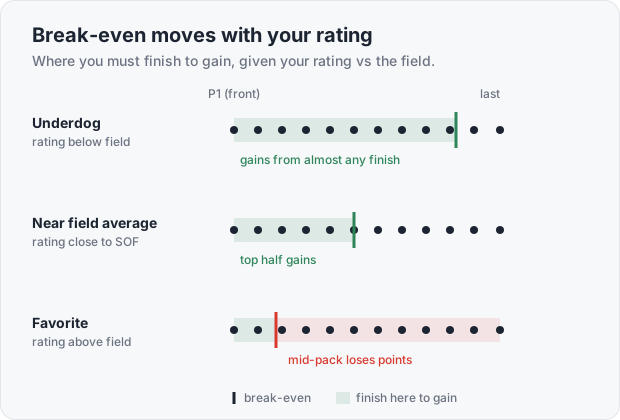
Section titled “Your break-even finish moves with your rating”Your break-even finishing position slides with your rating relative to the field. “Finish top half and you gain” holds only when your rating is near the field’s average.
SOF is the readout. Strength of Field is the average iRating of everyone in your split. It is not a term in the gain/loss formula, since each individual rating is already in the pairwise math, but it tracks how much a race is worth: a stronger field pays more for a win and costs less for a loss.
Why the line moves. iRacing’s own license-progression notes explain that a driver with a very high iRating in a split contributes heavily to its SOF and so has a tougher time earning more, while a low-rated driver in the same split gains more easily. Drop a 1k driver into an all-5k field and they gain from almost any finish, because beating even one car beats expectations. Put a 5k driver in a 2k field and they can finish third and still lose.
Splits group you with drivers near your number
Section titled “Splits group you with drivers near your number”Every signup for a session is sorted by iRating and sliced into lobbies of similar rating, each targeting a set field size. Twenty-five signups might run as one 25-car race or split into a 12 and a 13. You race the people nearest your number. In-race car numbers are assigned by iRating, descending, so #1 is the highest iRating in the split and the count drops from there, which lets you read the rating order without an overlay.
Participation, not difficulty, builds iRating faster
Section titled “Participation, not difficulty, builds iRating faster”Participation, not difficulty, is why ovals and popular classes climb faster than thin formula and open-wheel series. In a series drawing only a handful of splits per week the SOF can’t rise high, so even a top driver wins a small handful of points and a DNF still bleeds a lot. That caps the ceiling. In a packed series like GT3 or Porsche Cup, where hundreds of entries spread across many splits, weak drivers filter down into lower splits, your split’s SOF is higher, wins pay more, and losses cost less. The ceiling is much higher.
iRating is split by category rather than by car. iRacing tracks a separate number for Oval, Sports Car, Formula Car, Dirt Oval, and Dirt Road. When iRacing split the old Road license into Sports Car and Formula in 2024 Season 2, it copied each driver’s Road iRating into both new categories, so nobody reset. Moving from GT4 to GT3 keeps the same Sports Car iRating, since both live in the same category, but it can drop you mid-pack in results until you learn the faster car, so the rating bleeds off through losses rather than resetting. Switching category, say from Sports Car to Formula, is where you start fresh on a separate rating.
Climb by finishing top-half in a high-participation series
Section titled “Climb by finishing top-half in a high-participation series”Pick a high-participation series so the math works in your favor. (Startlight, our $9.99 iOS app with a Home Screen widget and Apple Watch app, shows which iRacing session is running now and the countdown to green, so the race you planned around doesn’t slip past you.) Then:
- Drive one car until the muscle memory is automatic. Switching cars and tracks every week keeps you mid-pack.
- Finish top half, every race. Consistency beats chasing alien lap times.
- Qualify well and hold a clean top-5. Track position is free iRating.
- Avoid catastrophic DNFs. Any full stop hands points to the whole field behind you, and on r/iRacing the most common climb advice is to keep the car running rather than to drive faster. Get a clean wheel under you first, see pedals and force feedback.
Frequently asked questions
How is iRating calculated in iRacing?
It's an Elo-style pairwise exchange against every other finisher: everyone who finishes ahead takes points from you, and you take points from everyone behind, scaled by the rating gap and averaged over the field. Beating a higher-rated driver pays more; losing to a lower-rated one costs more. It ignores incident points, where you started, positions gained or lost, and lap times. Only finishing order and the two ratings in each match matter.
Does Strength of Field (SOF) change my iRating gain?
Indirectly. SOF is the average iRating of everyone in your split, a readout rather than a formula input, but each driver's individual rating is already in the pairwise math. A higher-SOF field pays more for a win and costs less for a loss. The break-even finishing position depends on where your rating sits in the field: near the field average it lands around the middle, an underdog can gain finishing in the back half, and the favorite has to finish near the front to gain at all.
What is a good iRating?
Everyone starts at a provisional 1350, and the distribution is heavily right-skewed, so most active drivers sit between roughly 1,000 and 2,000 (see the live iRating distribution). Clearing 2,000 puts you ahead of the pack, 2,500-3,000 is genuinely quick, daily top splits run around 5,000-6,000, and big special-event top splits push an SOF of 8,000-9,000.
Why did my iRating drop when I finished mid-pack?
Because mid-pack was below your expected finish. The math compares you to each driver individually, so a high-rated driver in a weak field has to finish near the front just to break even, while a low-rated driver in a strong field can gain from a back-half result. 'Finish top half and you gain' is only the rule of thumb when your rating is close to the field's SOF.
Does iRating reset when I switch from GT4 to GT3?
No. iRating is split by category rather than by car, and GT4 and GT3 both live in the Sports Car category, so you keep the same number. You'll likely run mid-pack and bleed points through losses while you learn the faster car, rather than resetting. Only switching category, such as Sports Car to Formula, starts you fresh on a separate rating.
Is iRating the same as my license?
No. iRating is a matchmaking number that tracks how fast you finish relative to the field, and it gates nothing. Safety Rating measures corners per incident and is what promotes you through Rookie, D, C, B, A. They move independently, so you can sit at 1.5k iRating with an A license, or 3k iRating stuck on a D license because you wreck.