
Simagic GT Neo review: 18 controls for ~$240
Researched overview Manufacturer listings and owner reports, with no hands-on testing.
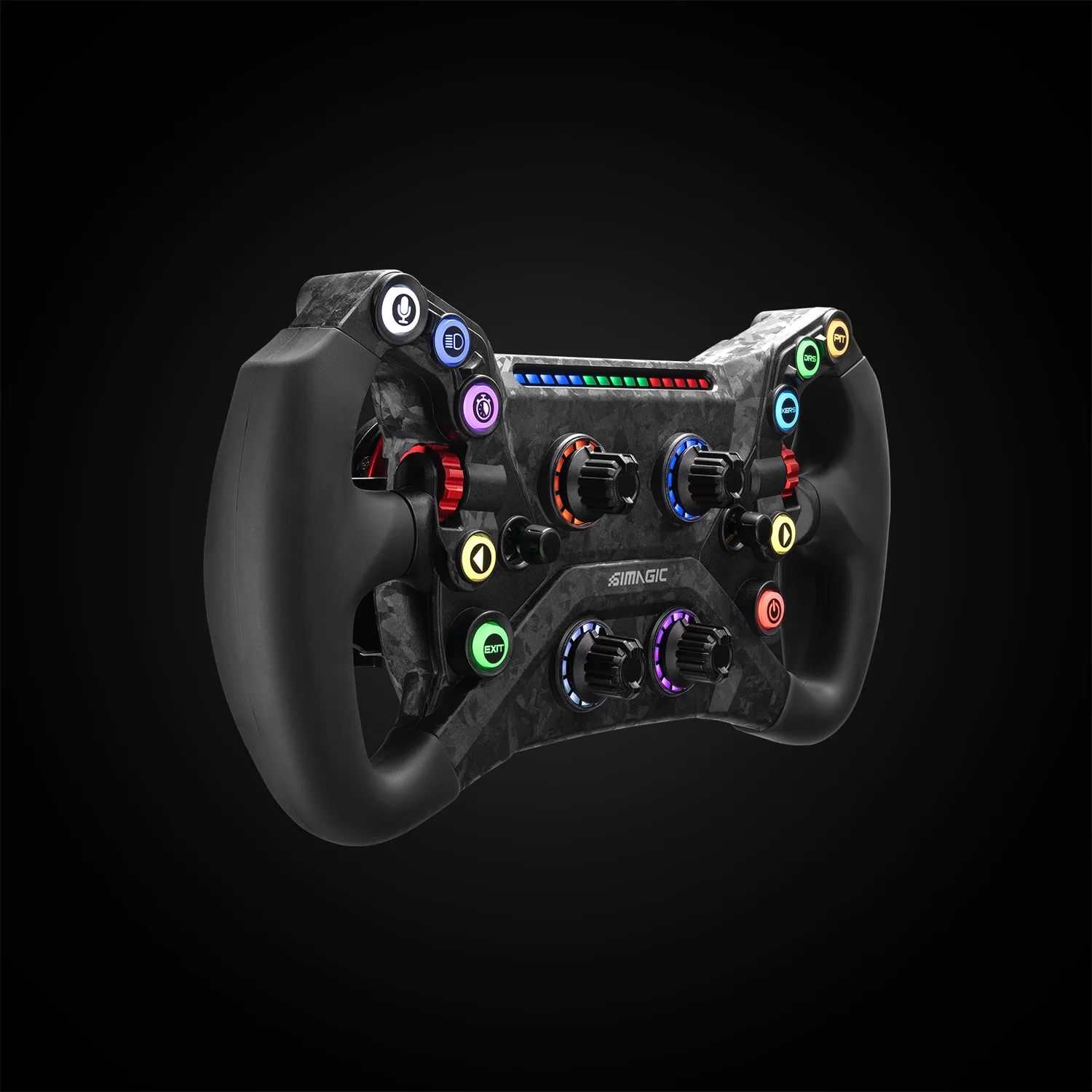
The Simagic GT Neo puts 18 controls on a 300 mm round face for ~$240: ten RGB push buttons, two seven-way funky switches, four 12-bit absolute rotary encoders, and two thumb encoders. Behind the rim sit dual magnetic shift paddles and two analog clutch paddles. The body is injection-molded carbon-fiber-reinforced composite over an aluminum back casing at ~1100 g, packing more control density and more rigidity than most GT wheels near this price.
| Type | Round GT wheel |
|---|---|
| Rim | 300 mm; carbon-fiber-reinforced composite faceplate over an aluminum back casing, rubberized leather grips; ~1100 g excl. quick release |
| Inputs | 10 RGB push buttons, 2 seven-way funky switches, 4 12-bit rotary encoders, 2 thumb encoders; dual magnetic shift paddles + dual analog clutch paddles |
| Display | No LCD dash; top-mounted RGB rev/shift LED strip only |
| Connectivity | Simagic QR50 + MagLink; native on Alpha / Alpha Mini / Alpha U / M10, and on the Alpha EVO family, which Simagic bundles it with. Third-party bases via MagLink cable or QR adapter; SimHub over the cable; standalone USB option. Configured in Simagic SimPro Manager. |
| Price | ~$239 sale (~$289 regular) on simagic.com US; EU runs higher (~€399) |
| Best for | Control-rich GT and endurance racing in the Simagic ecosystem without flagship pricing |
Who it’s for
Section titled “Who it’s for”A budget-to-midrange GT and endurance driver who wants a control-rich, premium-feeling round wheel for a Simagic Alpha base.
Buy it if:
- You want flagship-level control density: 10 RGB buttons, 2 funky switches, 6 encoders, and four paddles on one rim.
- You run a Simagic Alpha, Alpha Mini, Alpha U, M10, or Alpha EVO base and want native plug-and-play over the QR50.
- You value the analog clutch paddles for bite-point and launch control in GT and endurance racing.
Not the one if you race outside the Simagic ecosystem and don’t want a MagLink cable (look at the Fanatec ClubSport Universal Hub V2) or you want a built-in dash screen (a Fanatec ClubSport Formula V2.5 X has one).
Build and feel
Section titled “Build and feel”Carbon over aluminum. The faceplate is carbon-fiber-reinforced composite bonded to an aluminum back casing, so the rim doesn’t flex when you load a paddle hard mid-corner. The grips are rubberized leather, a smooth surface where a step-up GT rim runs napped suede. At ~1100 g it feels solid without adding so much rotating mass that the base has to fight it.
The funky switches. Two seven-way funky switches put menu navigation under your thumbs. You cycle traction control, brake bias, and map without lifting a hand off the wheel, seven positions to a switch. The ten RGB buttons backlight per function, so a glance confirms what you’re about to press.
Clutch paddles. The two analog clutch paddles read travel, not just on/off, which is what makes a proper launch possible. Set a bite point, pull both at the lights, then release one to feed the clutch off the line. The dual magnetic shift paddles use Hall-effect sensing with no metal contacts to wear, so the click stays consistent.
Watch-outs
Section titled “Watch-outs”- No onboard dash. You get a rev/shift LED strip and nothing else. Lap times, fuel, and tire temps live on an external dash or the in-game display, so budget for one if you don’t already run telemetry.
- SimPro Manager. Button mapping, RGB setup, and firmware all go through Simagic’s SimPro Manager, and the software isn’t the most intuitive. Plan to spend a session getting profiles right.
- Wired for full use. Cross-base and SimHub use needs the MagLink cable rather than running wireless. On a non-Simagic base you’re managing one more cable.
- Simagic-first. The native experience is on Simagic Alpha and M10 bases. Everywhere else you’re in adapter territory, which works but isn’t the plug-and-play it is in-house.
Alternatives to consider
Section titled “Alternatives to consider”- MOZA GS V2P: the closest GT competitor at $399, native one-cable integration if you’re already on a MOZA base.
- Asetek La Prima GT: ~$435 round GT setup pairing a button box with a Comfort+ rim, if you want a more modular front end.
- Fanatec ClubSport GT V2: ~$515 premium GT wheel for the Fanatec ecosystem when build and finish matter more than price.
- Fanatec ClubSport Universal Hub V2: ~$370 hub that lets you bring your own rim, on a Fanatec base rather than a Simagic one. You pick the rim, and the base under it still has to be a Fanatec.
If you’re pairing the GT Neo with a non-Simagic base, confirm the fit on the quick-release and cross-brand compatibility page before you order the MagLink cable.
Frequently asked questions
Does the Simagic GT Neo work on non-Simagic bases?
Yes, with a cable. It's native plug-and-play on Simagic Alpha, Alpha Mini, Alpha U, and M10 bases over the QR50 quick release, and on the Alpha EVO family too: Simagic sells "EVO Sport 9nm+GT Neo", "EVO 12nm+GT Neo", and "EVO PRO 18nm+GT Neo" as three of the fourteen Style options on the Alpha EVO base's own listing, read 3 August 2026. On a third-party base it runs through the MagLink cable or a QR adapter, it works with SimHub over that same cable, and there's a standalone USB option that drives the buttons without any Simagic base. The trade is one extra cable on any non-Simagic base. Which Simagic part goes where is in the Simagic QR guide.
Does the Simagic GT Neo have a dash screen?
No. There's a top-mounted RGB rev/shift LED strip and that's it. For lap times, fuel, and gear you pair it with an external dash or read the in-game display. If a built-in screen is a must, a formula wheel like the Fanatec ClubSport Formula V2.5 X carries an OLED.
Simagic GT Neo or MOZA GS V2P?
Pick by ecosystem. The GT Neo is cheaper (~$289 regular against the GS V2P's $399) and more portable across bases, with a MagLink cable, QR adapter, and a standalone USB mode. The MOZA GS V2P is the pick if you already run a MOZA base and want one-cable native integration. Both are round GT wheels with no dash screen.
What paddles does the GT Neo have?
Four magnetic Hall-effect paddle modules: dual magnetic shift paddles plus dual analog clutch paddles. The analog clutches let you set a bite point and do a two-paddle launch off the line, which a fixed digital paddle can't.