
VRS DirectForce Pro DFP15 review: 15Nm peak on a 21-bit encoder for $699
Researched overview Manufacturer listings and owner reports, with no hands-on testing.
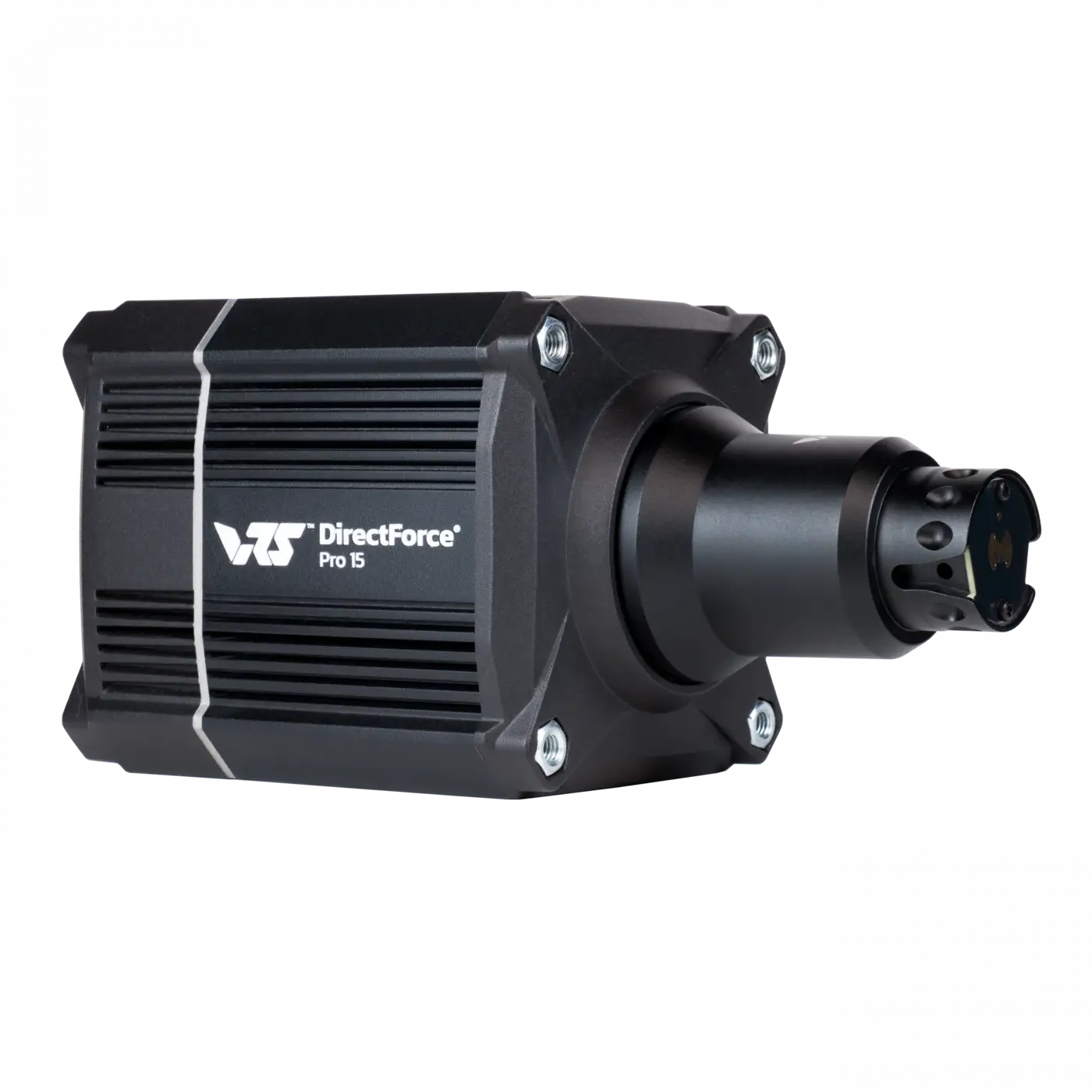
The VRS DFP15 makes 15Nm of peak torque from a 5-pole motor and a 21-bit encoder, and VRS lists it at $699 on its US store with no wheel and no pedals in the box. The controller lives inside the aluminum housing rather than in a box on the floor, which is the line VRS draws against the base above it in its own range: the 20Nm DFP20’s listing sells “The separate controller design,” and this one’s feature list reads “Integrated NRG-style QR & integrated Controller in a durable aluminum housing.”
The wheel is the next purchase and it is the only one. The quick release is built into the shaft, and VRS’s cheapest wheel, the $349 R295, ships with the wheel-side half preinstalled, so a base that steers is $1,048. Add VRS’s $649 Throttle & Brake pedal set and a full set of controls is $1,697. Those are US store prices read 31 July 2026, before the sales tax VRS adds at checkout.
| Drive type | Direct drive. VRS's spec row reads "FFB Drive System: Direct Drive" |
|---|---|
| Peak torque | 15Nm. VRS's spec row reads "Peak Torque: 15 Nm" and its feature list opens "15Nm Peak Torque" |
| Encoder | VRS's row reads "Encoder Resolution: 21-bits/10 kHz" |
| Motor | "Motor Type: 5-Pole Motor". VRS names no motor brand for this base |
| Price | $699 on VRS's US store, checked 31 July 2026, before tax; bare base, no wheel or pedals |
| Platforms | PC. VRS's spec table names PC and names no console anywhere, checked 31 July 2026 |
| Quick release | "Integrated (NRG / D1 style), with USB (High Speed) connectivity via slip ring". The wheel-side half comes on the wheel |
| Mounting | Front and bottom. Four M8 threaded holes at 102.5mm rectangular spacing on the front flange, four M8 or M6 profile nuts on the bottom, and "Side Mount Option: No" |
| Size and weight | 160 × 130 × 130 mm, 7.845 kg, on an external 200 W brick |
| Software | "App Functions: Supported (via our Config Tool)" |
| Best for | A PC racer who wants 15Nm and a short shopping list |
Who it’s for
Section titled “Who it’s for”High-end direct drive for the PC iRacer who can’t justify $1,400 and would rather spend the difference on pedals.
Buy it if:
- You want genuine high-end feel at $699, half a Simucube 3 Sport and $250 under an Asetek Forte.
- You’ll put the savings into a real load-cell pedal set instead of more torque.
- You race PC, and you have a rig rather than a desk.
Not the one if you need a console answer in writing (the Fanatec ClubSport DD+ states one) or you want the widest wheel range on the market, which VRS does not have.
What it’s like to drive
Section titled “What it’s like to drive”What 15Nm buys. Past roughly 10–12Nm you stop buying steering weight your arms can use and start buying slew rate and detail: how fast the motor reverses, how cleanly it renders a kerb. The 5-pole motor and the 21-bit encoder spend the money there. The torque guide covers why 15Nm is plenty.
Five poles, and no motor brand. VRS’s spec table for this base reads “Motor Type: 5-Pole Motor” and stops. The MiGE name belongs to the base above it, whose own spec table reads “Motor Type: 4-pole MIGE motor,” so a MiGE claim about the DFP15 is a DFP20 spec wearing a DFP15 name.
Filtering moved into the base. VRS calls its current force-feedback engine NextGen FFB and describes it on this base’s features page as “A ground-up redesign of our FFB engine, engineered to eliminate the compromise between responsiveness and smoothness,” with filters that “apply up to 100% of a cycle sooner” than one working on the sim’s output after each update. VRS also puts “360Hz iRacing ready” on the buy listing’s feature list, which is a claim about iRacing’s high-rate force-feedback path rather than about the USB link: the spec table gives that separately as “USB Refresh Rate: 1000 Hz.” The per-base tuning guide covers the settings to set first.
Watch-outs
Section titled “Watch-outs”- PC is the only platform VRS names. Its spec table answers “Platform: PC,” and neither console appears on the listing, the features page, or the FAQ. That is an absence rather than a denial, and it is still not a console path you can hold VRS to.
- Budget a wheel, not an adapter. The $89 QR Connect Wheel Adapter is sold “to connect 70mm PCD mounting pattern wheels to VRS DFP15,” which is a rim you already own. A VRS wheel needs none of it. What stands between $699 and a base that steers is the $349 R295.
- Rig, not desk. VRS’s spec table carries a “Desk Clamp” row whose value reads “to be defined,” and the one part VRS sells that holds this base to anything, the $49 Mounting Bracket, says outright that it “cannot connect your wheel base to a desk or table.” Plan on aluminum profile. See rigs.
- A small catalog. VRS’s US shop listed three steering wheels under its own Steering Wheels heading on 31 July 2026, and one of the three, the $350 Lite Formula, was sold out. Its Accessories heading covers six products for the whole range. The base’s own “Tested Compatibility (Not Limited To)” list names 16 wheels and 13 of them are other people’s, so third-party rims are the answer to the range rather than the exception.
- 15Nm is what it stays. VRS sells a second base, the uDFP20, at four torque rungs of 6, 9, 12, and 15Nm, with ten separately priced upgrade steps between them and up to 20Nm, $99 to $396. Every one of the ten names the uDFP20 and none names the DFP15, so this base makes 15Nm for as long as you own it. Buying the ladder instead costs $50 more for the same 15Nm, $749 against $699, and $99 more again for the $99 adapter a VRS wheel needs on that base and not on this one.
Alternatives to consider
Section titled “Alternatives to consider”- Asetek Forte: 18Nm on a 22-bit encoder for $949, if you want more torque and more resolution.
- Simucube 3 Sport: the same 15Nm for $1,399 plus the Link Hub it needs to operate, for the reference build, a 23-bit encoder, and Simucube’s support.
- Fanatec ClubSport DD+: 18Nm with a console license, if PC-only is the deal-breaker.
Price the wheel before you decide: $699 gets a base and $1,048 gets one that steers, and both figures are before pedals. Then spend what you saved over a Simucube on a load-cell brake, because braking consistency moves your lap times more than the jump from 15Nm to 18Nm. The high-end wheelbases overview and the buying guide by budget show where the DFP15 fits.
Which platforms it works on
- PC
- Yes“Platform: PC” VRS’s own listing, checked July 2026.The first row of VRS's own spec table. The rows under it name a USB communication method, a 1000 Hz USB refresh rate, a USB B port, and a config tool, and not one of them names an operating system, so "PC" is the whole of what VRS says a buyer plugs this into.
- PlayStation
- Listing does not say
- Xbox
- Listing does not say
- Console license
- Not recorded
- How it connects
- Plugs into a computer over USB“Communication Method: USB” “Connection Ports: DC 48V input, USB B, RJ45 safety stop connector” “USB cable”VRS’s own listing, checked July 2026.A USB B port on the base, a USB cable in the box, and no hub, control box, or second product between the two. That is the difference this base's own listing draws against the one above it in VRS's range: the DFP20's listing sells "The separate controller design ensures quick part swaps" (https://vrs.racing/us/product/pro-wheel-base-20nm, read 2026-07-31), while this one puts the controller in the housing. What the row does not say is which operating system is on the other end of the cable, and no page read for this record names one.
- R295 GT & Formula Steering Wheel
- Only through a wheelbase or hub“Communication Method: USB pass-trough via QR” “Compatible with our latest VRS DFP15 wheel base & backwards compatible with our uDFP20 wheel base using the QR Connect (u)DFP20 Adapter”that part’s own listing, checked July 2026.The wheel reaches a machine only through a base under it, and its own listing names two VRS bases and no other brand. It is not locked as hard as the quotation makes it sound: the quick release is NRG-style on both halves, so the mechanical fit is an open standard, and what VRS states nowhere read for this record is whether the electronics work on anybody else's base. The typo is VRS's own and is quoted as printed.
- Pro Pedals, Throttle & Brake
- Plugs into a computer over USB“USB Connection: PC” “Includes VRS® DirectForce® Pro Pedals Controller”that part’s own listing, checked July 2026.The pedals bring their own controller and their own USB cable, both on their own box list, so this purchase reaches a computer with no VRS base under it and survives leaving VRS. That is the half of the enough-to-drive total a buyer keeps if they change wheelbase brands. VRS says nothing on that listing about which other brands the pedals work with.
VRS names PC and names no console anywhere read for this record. The review this record now backs stated a denial instead, "No. PC only", which is a claim no VRS page makes: a spec row reading "Platform: PC" says which machine VRS supports and says nothing about the two it left out. The page now says what VRS says.
What’s in the box
- AC cable
- USB cable
- Quick Release rubber inserts
- Mounting Hardware
- 4x screw DIN 912 M8 x 20,
- 4x profile nut M8,
- 4x screw ISO 7380 M8 x 16
Read off the manufacturer’s own box list of 7 items, checked July 2026.
What that covers
- Wheel
- Not in the boxNo item on the seven-line box list steers the base. The quick-release rubber inserts that are on it are the friction pieces inside the mount, not anything a driver holds. What a wheel costs on top is the enough-to-steer total.
- Pedals
- Not in the boxNo item on the box list is a pedal. VRS sells the Pro Pedals as their own listing with their own controller, which is a second purchase rather than a part of this box.
- Clutch
- Not in the boxThe box list names no pedals, so there is no third pedal either.
- Power supply
- In part“AC cable” “Input Voltage: 110V~220V AC, external power brick (200W)”The cord and not the thing it feeds. VRS's spec table says this base runs off an external 200 W brick, and the box list names a mains cable and never a brick. What that leaves open is whether the brick ships: no line on the listing says it does, VRS sells no power supply in the six-product Accessories category of its own US shop, and nothing here settles it. The listing also says nothing about which region's plug the AC cable carries, which is the other thing a US buyer would want off this list.
- Quick release
- In part“Quick Release: Integrated (NRG / D1 style), with USB (High Speed) connectivity via slip ring” “Quick Release rubber inserts” “Integrated NRG-style QR & integrated Controller in a durable aluminum housing”The base half is built into the shaft rather than packed beside it, which is the bare-base case this state exists for: the wheel half arrives on the wheel. VRS sells that half on its own at $99 as "Quick Release - Wheel Side" for a rim that has none, and the rubber inserts on the box list are consumable pieces of the joint rather than the joint.
- Desk clamp
- Not in the boxNo item on the box list is a clamp or a fixture. VRS goes further than leaving one out: its own spec table carries a "Desk Clamp" row and the value printed in it reads "to be defined". So VRS raises the question on the listing and answers it with nothing, which is why this record carries no ready-on-a-desk total.
- Cables
- Included“USB cable” “Connection Ports: DC 48V input, USB B, RJ45 safety stop connector”One data cable, for the USB B port that reaches the computer. The third port on that row takes an RJ45 safety stop and no cable for it is on the box list, so a buyer who wants the e-stop VRS names on its features page is buying something this listing does not price.
- Mounting hardware
- Included“Mounting Hardware” “4x screw DIN 912 M8 x 20,” “4x profile nut M8,” “4x screw ISO 7380 M8 x 16”Four lines of the box list: two screw types in M8, four of each, and four M8 profile nuts of the kind the bottom mount rides in a rig's own extrusion. Which of the two screw types goes on which face is not stated anywhere read for this record, and neither is a tool, so the hex key these heads take is not on the list.
How it mounts
- Mounting pattern
- Front flange holes, profile nuts on the bottom“Mounting Method: Front and bottom mounts” “Bottom Mounting: Mounts via 4x M8 or M6 profile nuts” “Front Mounting: Front flange with 4x M8 threaded holes with 102.5 mm spacing in rectangular arrangement” “Side Mount Option: No”VRS’s own listing, checked July 2026.VRS names both faces, four fixings on each, an M8 thread on both, and one spacing figure. What it does not give is a spacing for the bottom face, a bolt circle for either, or a hole count for the front flange beyond the four. A reader with a rig plate in front of them can check the 102.5 mm rectangle against it and still cannot lay the base on its side, which VRS answers with one word.
- Desk or rig
- Rig“The VRS Mounting Bracket is designed to securely connect your wheel base to your sim rig.” “This mounting bracket cannot connect your wheel base to a desk or table.” “The VRS Mounting Bracket is compatible with both the VRS DirectForce Pro Wheel Base and the VRS DFP15 Wheel Base.”VRS’s own listing, checked July 2026.The $49 Mounting Bracket's own listing, which names this base and is the only part in VRS's six-product Accessories category that holds a base to anything. The third line is what makes it evidence here rather than evidence about the older base beside it. VRS also calls the bracket optional on the same page, "Depending on the type of sim racing rig you have, you may or may not need this optional mounting bracket", which is why none of the totals on this record prices it.“VRS® DirectForce® Pro hardware comes with screws to assemble the mounting bracket and attach the motor to it. Since each simulator rig has different requirements, we do not provide additional screws and bolts.”VRS’s own listing, checked July 2026.VRS's own FAQ, which answers a question about screws by assuming a simulator rig under the motor. It speaks for the DirectForce Pro hardware line rather than for this base by name, which is the weaker of the two blocks here and the reason it is second.VRS names a sim rig and rules a desk out in the same paragraph, on the Mounting Bracket's listing quoted below. This base's own listing settles nothing either way: it prints "to be defined" against a "Desk Clamp" row, and that row is the only place "desk" appears in its page text, with "table" and "rig" appearing 0 times there, all counted case-insensitively on 2026-07-31. So the answer comes off the bracket rather than off the base. This is a categorization of VRS's own sentences and not a torque threshold: no page read for this record states a torque above which a desk stops holding a base, and nothing in this field is one.
Optional upgrades
“Increased compatibility with third-party steering wheels via the QR Connect Wheel Adapter” VRS’s own words, naming one part, checked July 2026.
One part, off a bullet on this base's own feature list. VRS publishes no accessories category scoped to this base: its US shop files six products under one "Accessories" heading for the whole catalog, and this bullet is the only sentence on this listing that names one of them as a path on from this base.
- QR Connect Wheel Adapter
- $89“The QR Connect Wheel Adapter allows to connect 70mm PCD mounting pattern wheels to VRS DFP15 featuring the VRS QR Connect system.” “Direct connection to VRS Formula Pro/Lite wheels using cable with M8 plug” “Connection to any USB full-speed steering wheel using cable with USB A socket”Not a toll on the way to a working base, which is the thing about it worth stating twice. VRS sells it for a rim on the industry-standard 70 mm bolt pattern, and its own R295 arrives with the wheel-side quick release fitted, so nothing in the totals above buys this. It is also what makes the $350 Lite Formula a $439 purchase, since that wheel takes the M8 plug option above.
Frequently asked questions
Is 15Nm enough for a high-end base?
Yes. Past roughly 10–12Nm you stop buying usable steering weight and start buying slew rate and detail, so 15Nm is real headroom rather than a compromise. VRS pairs it with a 5-pole motor and an encoder its spec table gives as "21-bits/10 kHz," and those matter more here than the torque number. See the torque guide.
What else do I need to buy with the DFP15?
A wheel, and on VRS's own wheels nothing else. The quick release is built into the base ("Integrated (NRG / D1 style)" on its spec table) and the $349 R295 arrives with the wheel-side half preinstalled, so a base that steers is $1,048. Add the $649 Throttle & Brake set and a full set of controls is $1,697. The $89 QR Connect Wheel Adapter is what a third-party 70mm-PCD rim needs, not what a VRS wheel needs. US store prices read 31 July 2026, before tax.
DFP15 or Simucube 3 Sport?
Both make 15Nm of peak torque. The DFP15 is $699 against $1,399 for the Simucube 3 Sport, and the Simucube needs a Link Hub to operate on top of that. What the extra money buys is a 23-bit encoder over this one's 21-bit, the re-engineered Simucube control algorithm, and the build. Both carry a 3-year warranty. Prices read 31 July 2026.
Does the DFP15 work on Xbox or PlayStation?
VRS does not say. The first row of its spec table reads "Platform: PC," and "Xbox" and "PlayStation" appear nowhere on the buy listing, the features page, or VRS's FAQ, checked 31 July 2026. Nothing there claims a console and nothing there rules one out. If you need a console answer in writing, look at the Fanatec GT DD Pro on PS5 or the Fanatec ClubSport DD+ on Xbox.