
Asetek Forte review: 18Nm peak and holding on a 22-bit encoder
Researched overview Manufacturer listings and owner reports, with no hands-on testing.
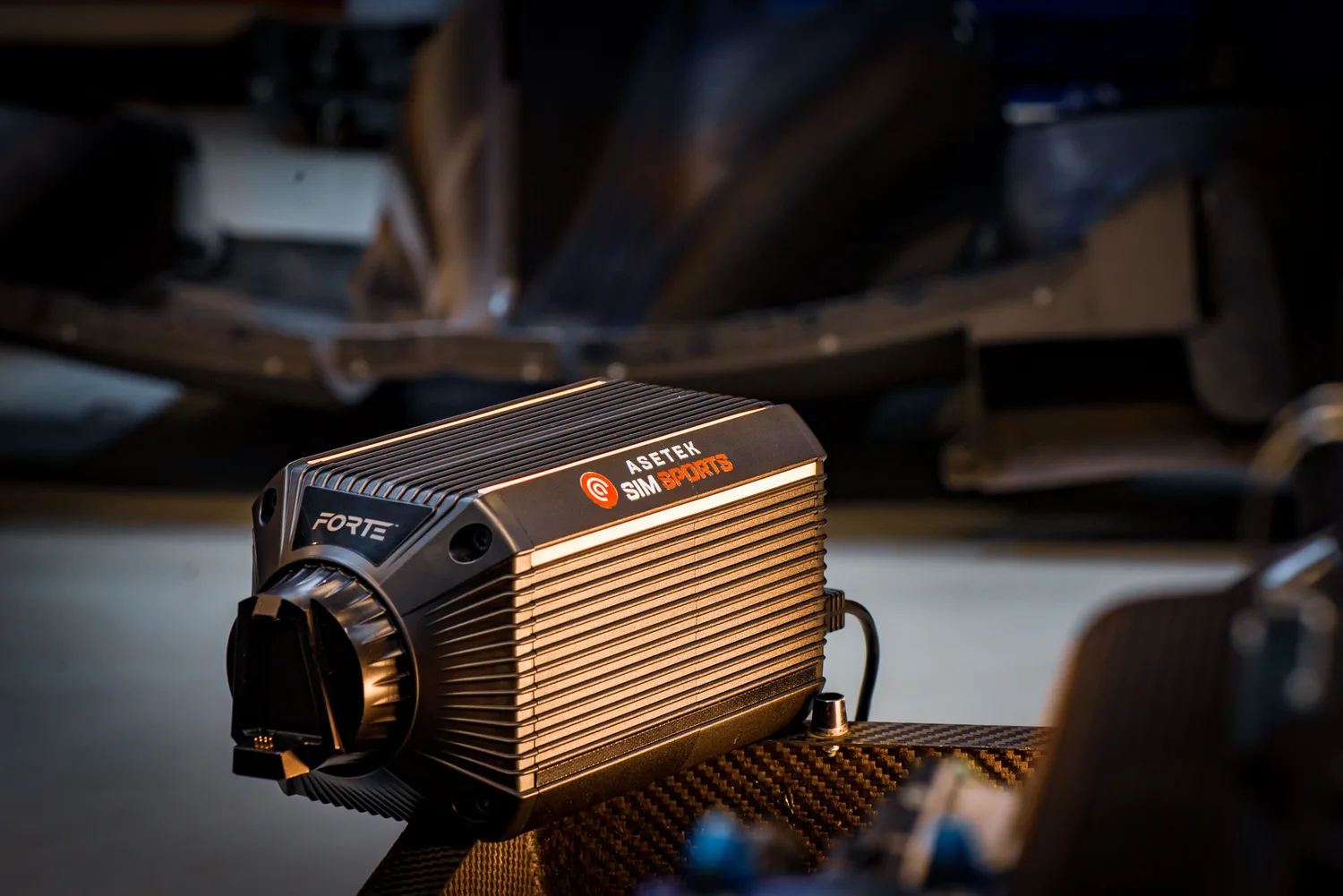
The Asetek Forte makes 18Nm and shares its 22-bit encoder with the 12Nm La Prima below it and the 27Nm Invicta above it. Asetek gives all three bases the same encoder resolution, the same 0.000085° step, and the same anodized extruded aluminum housing. What the $949 buys over the La Prima’s $679 is 6Nm more torque, a slew rate of 6.7 Nm/ms against 4, and a 400W power supply in place of a 180W one. The quick release is fitted at the factory, and the box holds a 400W power supply, three regional power cords, and a USB cable, so the base plugs in on the day it lands and steers nothing until you add a wheel.
| Drive type | Direct drive. Asetek's spec row reads "Force Feedback: Direct Drive" |
|---|---|
| Max torque | 18Nm. Asetek's row reads "Max Torque: 18Nm peak/holding", and defines holding torque as "continuous output for up to 40 seconds" |
| Encoder | 22 bit absolute, 0.000085° per step, "approximately 4,000,000 steps in a single revolution" |
| Price | $949 on Asetek's US store, checked 31 July 2026, excluding sales tax; bare base, no wheel or pedals |
| Platforms | PC, Windows 10 and 11. Asetek names no console on its listing, checked 31 July 2026 |
| Quick release | Asetek Racing Quick Release, base-side half fitted at the factory |
| Size and weight | 133 × 132 × 293 mm including the quick release, 8.5 kg |
| Software | Asetek RaceHub |
| Best for | A PC racer who wants 18Nm and a 22-bit encoder in one box |
Who it’s for
Section titled “Who it’s for”18Nm and a 22-bit encoder for the PC racer buying a base once.
Buy it if:
- You want 18Nm today and the resolution to go with it, not the cheapest route to a number.
- You want the wheel side settled at purchase: Asetek fits its quick release to the base and integrates the other half into its own wheels, so nothing extra is needed to hang a rim on it.
- You race PC and will add a steering wheel on top of the $949. Asetek’s cheapest complete wheel is the $149 Initium Steering Wheel (PC), which puts a steering setup at $1,098.
Not the one if 15Nm is enough forever (the VRS DFP15 does that for less), if you need a console (the Fanatec ClubSport DD+), or if you are buying in on the promise of climbing to 27Nm later, which Asetek does not currently sell.
What it’s like to drive
Section titled “What it’s like to drive”18Nm is headroom. Past roughly 10–12Nm the extra Nm is headroom, not steering weight your arms will use, so most drivers run the Forte well below its ceiling. The torque guide covers why the encoder, not the 18Nm, is doing the work.
What you feel. What you actually feel is the 22-bit encoder: the resolution that renders small surface texture and the front tire loading under braking. Asetek puts a number on it, “approximately 4,000,000 steps in a single revolution of the wheel”, which is one step every 0.000085°. Trim the in-game gain to taste; the per-base tuning guide has Asetek starting points.
Where 18Nm sits in the line. The encoder is the same across the range and the slew rate is not. Asetek gives the La Prima 4 Nm/ms, the Forte 6.7 Nm/ms, and the Invicta 9.4 Nm/ms, which is how fast each motor can change what it is doing. That figure moves with the torque, so the step up the line buys speed as well as weight.
Watch-outs
Section titled “Watch-outs”- The 27Nm upgrade path is not a product you can buy. Asetek’s own Upgrade Kits category listed nine kits on 31 July 2026 and none of them touches this base. The one Forte kit in the catalog is unpublished and has no page of its own, and the card naming it links to a URL that returns Asetek’s “Page not found”. Budget for the base you are buying.
- 8.5 kg and 293 mm long. Plan rig space and a solid mount. Nothing in the box bolts it down: the T-nuts arrive preinstalled in the bottom slots and every bracket is a separate purchase, from the $59 Bottom Mount to the $149 Front Mount. The cheapest way onto a desk is the $79.99 Bottom Mount w. Table Clamps, which closes on a surface up to 37mm thick.
- Asetek’s quick release, or an adapter. The base ships Asetek’s own system, so a rim from another brand needs the Invicta Quick Release Adapter, which Asetek describes as making it “possible to mount any steering wheel with a standard hole pattern on your Asetek Racing Wheelbase”.
- No console support is claimed. Asetek names PC three times on the listing and neither console anywhere. It has also published no denial, so buy this one for a PC and buy elsewhere if you need an Xbox or a PlayStation.
- 18Nm needs a stiff rig and a solid mount. A frame that flexes under it will mask the resolution you’re paying for.
Alternatives to consider
Section titled “Alternatives to consider”- VRS DirectForce Pro DFP15: 15Nm for less money, if you don’t need the extra torque.
- Simucube 3 Sport: the reference build, FFB algorithm, and support, if those matter more than peak Nm.
- Fanatec ClubSport DD+: also 18Nm, with a console license, if you need Xbox or PlayStation.
- Asetek La Prima: the same encoder and housing at 12Nm and 4 Nm/ms for $679, if the 18Nm is more than your cars ask for.
If 18Nm and a 22-bit encoder are what you want, this is a clean way to buy both; if you were buying it as a rung on a ladder, spend less on the base and put the difference into a load-cell brake. The high-end wheelbases overview and the buying guide by budget show where the Forte fits.
Which platforms it works on
- PC
- Yes“Compatibility: PC” “Platform:” “PC: Yes” “Operating System: Windows 10, 11” “Q: Which platforms and games are supported? A: The Forte® Direct Drive Wheelbase is compatible with PC and supports Windows 10 and 11.” Asetek Racing’s own listing, checked July 2026.Three surfaces on one listing: the compatibility badge under the product title, the Platform block at the foot of the spec table, and the FAQ. The FAQ is the strongest of the three because it is Asetek answering "which platforms" and naming one.
- PlayStation
- Listing does not say
- Xbox
- Listing does not say
- Console license
- Not recorded
- How it connects
- Plugs into a computer over USB“USB Hub: 5 port USB C” “USB-C to USB-A cable (x1)” “The wheelbase will serve as the central hub in your simulator, where you can connect your Asetek Racing™ pedals, wheels and future peripherals with up to 5 USB-C ports in the rear.”Asetek Racing’s own listing, checked July 2026.The base reaches a computer on the cable in its own box and steers nothing until the enough-to-steer total is spent. The five rear ports are the other direction, a hub for peripherals rather than a second way out, and Asetek names its own pedals and wheels as what goes in them. Nothing on this listing says whether a port takes hardware from another brand.
- Initium Steering Wheel (PC)
- Only through a wheelbase or hub“Connection: Asetek Quick Release” “Integrated Quick Release system for a cable-free experience”that part’s own listing, checked July 2026.The wheel reaches a machine only on a base under it, and only on a base carrying Asetek's quick release. Its box list runs four items, the wheel, a tweezer, a sticker sheet, and two shifter paddles, and holds no cable of any kind, which is the "cable-free" the second line names.
- Initium Pedal Set
- Plugs into a computer over USB“Connection to host: Type-C connector (USB or CAN bus)” “USB-C to USB-C cable” “Q: Is the Initium Pedal Set compatible with PC? A: Yes, the Initium Pedal Set is PC compatible and connects via a Type-C connector using USB or CAN bus.”that part’s own listing, checked July 2026.The pedals reach a host on their own connector, with the cable for it on their own box list, so this purchase survives leaving Asetek in a way the wheel above it does not. Asetek says "host" rather than "PC" in the spec row and answers PC in the FAQ, and it says nothing about other brands' bases either way.
Asetek has neither claimed nor denied either console. Counted case-insensitively in the served HTML of the US listing on 2026-07-31, "Xbox" appears 7 times and "PlayStation" 4 times, and every one of the 11 is inside a JavaScript config for the compatibility badge that ships on every product page, of the form '"xbox":{"tooltip":"Compatible with Xbox","href_disabled":"/compatibility/xbox/"}'. None of them renders: the badge on this page reads "Compatibility: PC" and nothing else, and the spec table's Platform block names one machine. A shared script naming every platform a store sells for is not a claim about this product, so both consoles are recorded as unstated rather than as denied.
What’s in the box
- Forte® Direct Drive Wheelbase (x1)
- US Power Cord 1.5m (x1)
- EU Power Cord 1.5m (x1)
- UK Power Cord 1.5m (x1)
- ON/OFF button box (x1)
- Torque OFF button box (x1)
- Power Supply 400W (x1)
- USB-C to USB-A cable (x1)
Read off the manufacturer’s own box list of 8 items, checked July 2026.
What that covers
- Wheel
- Not in the boxNo item on the eight-line box list steers the base. The two button boxes that are on it are an ON/OFF switch and a torque cut-off, which are panels wired to the base rather than anything a rim bolts to. What a wheel costs on top is the enough-to-steer total.
- Pedals
- Not in the boxNo item on the box list is a pedal. Asetek sells nine pedal products in a category of their own, which is a catalog rather than a box.
- Clutch
- Not in the boxThe box list names no pedals, so there is no third pedal either.
- Power supply
- Included“Power Supply 400W (x1)” “US Power Cord 1.5m (x1)” “EU Power Cord 1.5m (x1)” “UK Power Cord 1.5m (x1)” “Power Supply: 400 W”The brick and all three regional cords, so this box needs no adapter in any of the markets Asetek's cords cover. The last line is the spec table's own row for the same part.
- Quick release
- In part“Quick Release: Asetek Racing™ Quick Release Included” “Length (incl. Quick Release): 293 mm” “All Asetek Racing™ wheelbases feature our own Quick Release System which is as easy to use as shifting gear – literally.”The base-side half, fitted at the factory rather than packed: the spec table calls it included and the dimensions row measures the base with it on. That is half of a quick release, because no wheel in this box carries the other half. Nothing extra has to be bought for it, though, since Asetek builds the wheel-side half into its own wheels, which the enough-to-steer total's own parts record.
- Desk clamp
- Not in the box“Asetek SimSports® Bottom Mount w. Table Clamps”The name of a $79.99 product Asetek cross-sells under "COMPLETE YOUR SETUP" on this listing, and no item on the box list is a clamp or a fixture. That $79.99 is what the ready-on-a-desk total buys.
- Cables
- Included“USB-C to USB-A cable (x1)”One data cable, for the base's own input. The five USB-C ports the spec table gives as a hub are for peripherals and the box carries no cable for them, so a wheel or a pedal set bought later brings its own: the Initium Pedal Set's box list names a "USB-C to USB-C cable" of its own.
- Mounting hardware
- In part“In its simplest mounting form (default from factory), the bases come with T-nuts pre-installed in bottom grooves, enabling the motor to slide back and forth in your rig without installing long and expensive steering wheel spacers that ultimately can compromise the life and reliability of your wheelbase.”T-nuts and nothing else. They arrive in the base's own slots rather than in the box, which is Asetek supplying them, and no bolt, washer, bracket, or tool appears on the box list. Every bracket Asetek makes for this base is a separate purchase, from the $59 Bottom Mount to the $149 Front Mount, so the box does part of what this category names and stops.
How it mounts
- Mounting pattern
- T-slots on the bottom, T-nuts preinstalled“In its simplest mounting form (default from factory), the bases come with T-nuts pre-installed in bottom grooves, enabling the motor to slide back and forth in your rig without installing long and expensive steering wheel spacers that ultimately can compromise the life and reliability of your wheelbase.” “For all wheelbases, we have developed mounting options for any rig, ranging from a bottom mount, side mount, and all the way to our integrated front mounts.”Asetek Racing’s own listing, checked July 2026.Asetek names the face, the slots, and the T-nuts already sitting in them, and never a hole count, a slot spacing, or a thread size. The second line is about the brackets Asetek sells rather than about the base, so it says what a bracket reaches and not that the base carries a second set of slots. A reader asking whether a particular rig plate lines up gets no answer from either line. What Asetek publishes for that is a mounting-schematics download.
- Desk or rig
- Desk clamp or rig“The Bottom Mount can be mounted directly onto your table or on your rig.” “You mount your Asetek Racing™ Direct Drive wheelbase by attaching the bottom mount to the underside of the wheelbase and then mount it to your rig in your preferred position.” “The t-slots in the bottom of the wheelbase allows you to slide your wheelbase back and forth on the bracket.”Asetek Racing’s own listing, checked July 2026.The $59 Bottom Mount's own listing, which names the class this base is in rather than this base, and is the one Asetek page read for this record that puts a wheelbase on a table in a sentence. It is also where the third quotation comes from, which describes the base's own slots from the bracket's side.“Mount your wheelbase to most horizontal surfaces.” “With the Bottom Mount w. Table Clamps, you get a very versatile mounting solution, that enables you to mount your wheelbase to either a horizontal surface, wheel deck or aluminum rig.” “It is mountable to a vertical surface with a thickness up to 37mm.”Asetek Racing’s own listing, checked July 2026.The $79.99 product in the ready-on-a-desk total. Its listing says "your wheelbase" rather than naming this one; what ties it to this base is the Forte's own listing, which cross-sells it under "COMPLETE YOUR SETUP" and again under "Pairs Well With". The 37mm is the thickest desk the clamps close on.“For all wheelbases, we have developed mounting options for any rig, ranging from a bottom mount, side mount, and all the way to our integrated front mounts.”Asetek Racing’s own listing, checked July 2026.The rig half, on the Forte's own listing. It names three brackets and Asetek sells each of them separately, at $59, $59, and $149 on the check date.Asetek names a table and a rig, and requires neither. Both take a bracket sold separately, which is the difference between this answer and a base that ships a clamp. No Asetek page read for this record states a torque above which a desk stops holding a base, and nothing in this field is one.
Optional upgrades
“An Upgrade Mindset” “Our goal is to transform the way you acquire, use, and upgrade your sim racing hardware, providing a future-proof platform that facilitates simple and easy upgrades for your hardware whenever you need it.” “You simply buy your preferred upgrade kit, and all you pay for is the upgrade kit itself.” Asetek Racing’s own words, naming one part, checked July 2026.
One kit, and it is the tenth. The nine in Asetek's published Upgrade Kits category on the check date upgrade Initium pedals, La Prima pedals, a La Prima clutch, and a La Prima wheelbase, and not one of them upgrades this base. Two of the nine carry another product line's name in the title and still do not, the "La Prima™ to Forte® Pedal Upgrade Kit" and the "La Prima™ Clutch to Invicta™ Clutch Upgrade Kit", because both are pedal parts. The nearest published one is worth naming for what it is not: the $149 La Prima Wheelbase Boost Kit takes a La Prima "increasing output to 16 Nm of torque", which is a step to 16 Nm on the base below this one rather than a step off this one.
- Private: Forte® to Invicta™ Upgrade Kit
- $299.99“Private: Forte® to Invicta™ Upgrade Kit”Named and priced by Asetek, and orderable by nobody. The name is the product's own title with WordPress's unpublished-post prefix on the front of it, printed exactly as the page printed it. The link goes to another product's page because this kit has no page of its own: the $299.99 was read on a cross-sell card there, and that card's own link points at WordPress's post-ID fallback URL, which returns Asetek's "Page not found". Two things this leaves unanswered, because no Asetek page read for this record settles them: what is in the kit, and whether fitting it turns an 18 Nm base into the 27 Nm the Invicta's own spec table gives.
Frequently asked questions
Can I upgrade the Forte to the 27Nm Invicta later?
Not from anything Asetek sells you today. Its US Upgrade Kits category counted itself at "9 out of 9 products" on 31 July 2026 and not one of the nine upgrades this wheelbase: five are Initium kits, one is the La Prima Wheelbase Boost Kit, one is a hydraulic brake kit, and the two that carry another line's name in the title upgrade pedals rather than a base, the "La Prima™ to Forte® Pedal Upgrade Kit" and the "La Prima™ Clutch to Invicta™ Clutch Upgrade Kit". A tenth exists in Asetek's catalog and is not for sale. A card reading "Private: Forte® to Invicta™ Upgrade Kit" at $299.99 appears in the cross-sell carousel on the La Prima Wheelbase Boost Kit page, carrying WordPress's unpublished-post prefix, and its link goes to a post-ID URL that returns Asetek's "Page not found". Buy the Forte for its 18Nm, not for a step to 27Nm.
Is 18Nm too much torque?
For most drivers you'll run it well below the ceiling. Past roughly 10–12Nm extra torque is headroom rather than usable steering weight, and the resolution from the 22-bit encoder matters more than the Nm. See the torque guide.
Asetek Forte or VRS DFP15?
The VRS DFP15 makes 15Nm for less money. The Forte adds 3Nm and a 22-bit encoder. If 15Nm is your ceiling, save the difference.
Does the Forte work on console?
Treat it as a PC base. Asetek answers the platform question with PC three times on its own listing and names no console: the compatibility badge under the title reads "Compatibility: PC", the spec table's Platform block reads "PC: Yes" and "Operating System: Windows 10, 11", and the FAQ answers "Which platforms and games are supported?" with "compatible with PC and supports Windows 10 and 11", checked 31 July 2026. It has published no denial either, so nothing here says the hardware fails on a console, only that no console support is claimed. For an 18Nm base whose maker states a console license, the Fanatec ClubSport DD+ is the closest equivalent.