MOZA FSR2 Formula Wheel review: the $649 carbon rim with a real touchscreen
Researched overview Manufacturer listings and owner reports, with no hands-on testing.
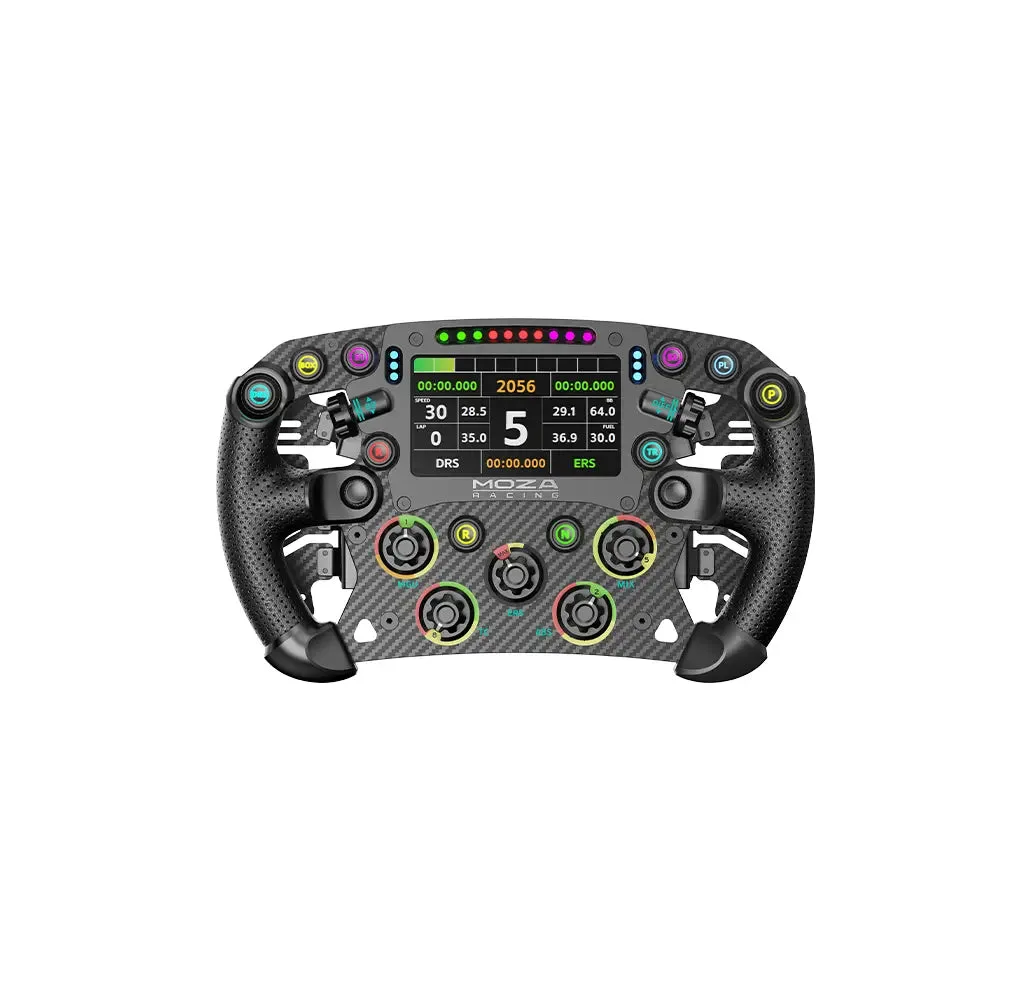
The MOZA FSR2 is a $649 formula wheel on a 280mm open-bottom carbon rim, and it carries a 4.3-inch color touchscreen most rims near this price skip. The face is 5mm of 3K twill carbon over an aerospace-grade aluminum back plate, so it feels like a real formula rim rather than molded plastic. Behind it, six magnetic Hall-effect paddles split into dual shift, dual analog clutch, and dual programmable, and the screen puts live telemetry on the wheel instead of an alt-tab away.
| Type | Formula wheel (open-bottom) |
|---|---|
| Rim | 280mm formula-style; 5mm 3K twill carbon fiber face, aluminum alloy back plate, perforated microfiber leather grips |
| Inputs | 10 backlit RGB buttons, 2 rotary encoders, 3 thumb encoders, 2 seven-way funky switches, 6 magnetic Hall-effect carbon paddles (dual shift, dual analog clutch, dual programmable) |
| Display | 4.3-inch 480p color touchscreen (60Hz, 1.3GHz quad-core), 10 RGB shift LEDs, 6 side signal LEDs |
| Connectivity | All-aluminum MOZA quick-release; native on all MOZA bases (R3/R5/R9/R12/R16/R21); non-MOZA bases via the MOZA Universal Hub / adapter |
| Price | ~$649 USD (~$929 CAD) |
| Best for | MOZA-ecosystem racers wanting a carbon formula wheel with a real telemetry touchscreen below flagship money |
Who it’s for
Section titled “Who it’s for”A feature-rich carbon formula wheel for sim racers already on a MOZA base, or planning to land on one.
Buy it if:
- You run a MOZA wheelbase (R3 through R21) and want a rim that bolts straight on over the quick-release.
- You want on-wheel telemetry. The 4.3-inch touchscreen shows tire, fuel, and lap data without alt-tabbing to the PC.
- You drive open-wheelers and want the open-bottom rim, dual analog clutches for standing starts, and programmable DRS/KERS paddles.
Not the one if you mostly race GT3 and want a round rim (the MOZA GS V2P), or you’re on a Fanatec base and want a native-fit formula wheel (the Fanatec ClubSport Formula V2.5 X).
Build and feel
Section titled “Build and feel”Carbon and aluminum. The face plate is 5mm of 3K twill carbon fiber over an aerospace-grade aluminum back plate, with perforated microfiber leather grips. It feels closer to a real formula rim than the plastic-and-rubber wheels a step down, and the carbon keeps the rim light on the shaft so the base doesn’t drag extra rotating mass.
Six magnetic paddles. Behind the rim sit six carbon-fiber paddles on magnetic Hall-effect sensors: dual shift, dual analog clutch, and two programmable paddles for DRS, KERS, or multi-function mapping. Hall-effect sensing has no contacts to wear, so the shift paddles click crisp and consistent over time, and the analog clutches let you set a bite point for clean standing starts. The wheel button mapping guide covers laying the rest out.
The 4.3-inch screen. The touchscreen runs 480p at 60Hz on a 1.3GHz quad-core processor, so live telemetry, tire and fuel readouts, and setting changes happen on the wheel rather than in a PC window. Above it, 10 RGB shift LEDs flash the upshift point and 6 side signal LEDs carry flags and alerts. The 10 backlit RGB buttons, 2 rotary encoders, 3 thumb encoders, and 2 seven-way funky switches give you enough inputs to map a full endurance car.
Watch-outs
Section titled “Watch-outs”- MOZA-first by design. It bolts native to MOZA bases. On a non-MOZA base you must buy the separately sold MOZA Universal Hub / wheel adapter, which adds cost and a compatibility layer to manage. See quick-release and cross-brand fit.
- No port of its own. The FSR2 has no USB connection, so it does nothing until it is fitted to something. MOZA names two things: one of its bases, or the Universal Hub Kit at $59.00 regular, whose own listing calls it a “USB hub” that connects MOZA wheels “to a PC, providing power and data” and names the FSR2 among the four wheels it supports. Budget for one or the other if you don’t already own a base; the buying guide by budget shows where it fits.
- A real learning curve. The touchscreen and the depth of mappable inputs reward setup time. Expect to spend a session mapping buttons and configuring the dash in MOZA Pit House before it does what you want.
The $749.00 MOZA wheel one step up is a round GT rim
Section titled “The $749.00 MOZA wheel one step up is a round GT rim”MOZA’s next wheel above this one is the Vision GS at $749.00 regular, $100.00 up, and nothing in MOZA’s 13-wheel range sits between the two. It is not a formula wheel. It is a 310mm round GT rim with a 2.85-inch circular touchscreen in the middle of it, so the $100.00 buys a different discipline rather than more of the same wheel. MOZA sells them off separate listings and offers neither against the other on any picker.
| Wheel | Price, MOZA US store, 2 August 2026 | Generation | Lifecycle | How MOZA’s spec block differs from the FSR2’s | Buy |
|---|---|---|---|---|---|
| Moza Racing Vision GS Wheel | $749.00 regular, $699.00 that day | None published | Current, in MOZA’s US steering-wheel collection on 2 August 2026 | ”Size: 310mm” against “280mm formula-style steering wheel”; “Display Screen: 2.85-inch high-definition circular screen” against “4.3-inch touchscreen display”; “Face Plate Material: Carbon fiber reinforced composite” against “5mm-thick 3K twill carbon fiber”; “Grip Material: Microfiber leather” against “Perforated microfiber leather”; “Short-Travel Backlit Buttons: 8” against 10; “Shift Paddles: Carbon fiber magnetic shift paddles” against “Hall sensor magnetic carbon fiber paddles”. It adds “Rear Buttons: 2”, “Universal Joystick: 1”, and a “Communication Methods” row the FSR2’s listing has none of, and it carries no counterpart to the FSR2’s “Signal Lights: 6 LED side-mounted signal lights” | MOZA |
MOZA describes the two wheels with two different vocabularies. MOZA publishes 22 rows for the Vision GS and 20 for the FSR2, and 13 labels appear on both. Four of the 13 carry the same value: “Back Plate Material: Aerospace-grade aluminum alloy”, “Display UI: Fully customizable”, “Fully Adjustable RPM LEDs through MOZA Pit House: Supported”, and “Release Method: All-aluminum quick release”. The other nine differ. That leaves 7 FSR2 rows and 9 Vision GS rows with no counterpart, and five of those pairs are plainly the same field written two ways: “Rotary Encoders” against “Aluminum Alloy Rotary Encoders”, “Thumb Encoders” against “Aluminum Alloy Thumb Encoders”, “7-Way Switches” against “7-Way Switch”, “Smart Telemetry” against “Intelligent Telemetry”, and “Backlit Color Options for Buttons” against “Backlit Buttons Colors”. Reading those five as matches leaves 2 FSR2 rows and 4 Vision GS rows genuinely unanswered, and that reading is this site’s rather than MOZA’s.
MOZA counts more of most controls on the FSR2, and two kinds only on the Vision GS. It gives the FSR2 10 backlit buttons against 8, two 7-way switches against one, and three thumb encoders against two, plus “Signal Lights: 6 LED side-mounted signal lights” the Vision GS has no row for. The Vision GS takes three rotary encoders against two, and adds “Rear Buttons: 2” and “Universal Joystick: 1”, neither of which the FSR2 has a row for. It also carries a “72 Programmable Input Signals” claim on MOZA’s overview page. The word “input” appears nowhere on the FSR2’s listing, so the two cannot be compared on a headline total.
Both wheels have two MOZA pages that disagree about wireless, in opposite directions. The Vision GS listing states “Communication Methods: Via conductive slip ring”, which is wired, and its own FAQ then reads “Yes. The Vision GS supports both wireless and wired communication” while MOZA’s overview page for it heads a block “Wireless & Conductive Slip Ring”. The FSR2 listing states no connection row at all, and MOZA’s overview page for the FSR2 adds one the listing does not have: “Communication Methods: Wireless or via conductive slip ring”. So on both wheels the second page is the one that says wireless, and on neither does MOZA reconcile the two.
Neither listing says which MOZA bases its wheel refuses. Both give a one-line answer instead: “Compatibility: Compatible with all MOZA wheelbases; works with 3rd party wheelbases via MOZA hub” on the FSR2, and “Compatibility: It is compatible with all MOZA wheelbases and works with 3rd party wheelbases via the MOZA hub.” on the Vision GS. The MOZA wheel catalog sets all 13 listings against each other on that question, including the two wheels whose listings do name individual bases.
Both wheels are named by the same hub. MOZA’s Universal Hub Kit, $59.00 regular and $39.00 on 2 August 2026, lists four wheels it supports, “KS Wheels, FSR2 Formula Wheel, MOZA Vision GS Wheel, MOZA TSW Truck Wheel”, so the route off a MOZA base is the same purchase for either. What the Vision GS gets that the FSR2 does not is MOZA’s own sentence about where that route ends: its overview page says the wheel “can be directly connected to a PC via MOZA’s universal adapter”. The FSR2’s pages say nothing of the kind, and the hub kit’s box carries a “Retractable Coil Cord for FSR wheel (3m)” that the Vision GS is not named for.
Every Vision GS figure and quotation above was read on 2 August 2026 off MOZA’s Vision GS listing, its overview page, the steering wheels collection, and the Universal Hub Kit listing. The FSR2 spec rows quoted beside them were read off its own listing the same day, which showed $649.00 with a crossed-out figure equal to it, and the FSR2 connection row that the listing does not carry was read off MOZA’s FSR2 overview page.
Alternatives to consider
Section titled “Alternatives to consider”- Simagic FX Pro: ~$549 carbon formula rim on the Simagic ecosystem, a step cheaper if you’re already on a Simagic base.
- Fanatec ClubSport Formula V2.5 X: $439.99 formula wheel for Fanatec bases, with an OLED dash rather than a full touchscreen.
- Ascher Racing F28-SC V2: ~$779 formula wheel with magnetic shifters and broad base compatibility, if you want to spend up.
- Fanatec ClubSport Universal Hub V2: ~$370 hub if you’d rather bring your own rim and buttons to a Fanatec base.
If you’re not yet on a MOZA base, pair the FSR2 with a Moza R5 or R9 first, because the wheelbase sets how the car feels in your hands. The wheel rims and quick-release guide covers fitting it to a base you already own.
Which platforms it works on
- PC
- Listing does not say
- PlayStation
- Listing does not say
- Xbox
- Listing does not say
- Console license
- Not recorded
- How it connects
- Only through a wheelbase or hub“Compatibility: Compatible with all MOZA wheelbases; works with 3rd party wheelbases via MOZA hub” “Yes. The FSR2 is compatible with all MOZA wheelbases and can also connect to third-party wheelbases via the MOZA Universal Hub Kit. This ensures broad compatibility across most sim racing setups.”Moza Racing’s own listing, checked July 2026.The first line is the spec accordion headed “FSR2 Formula Wheel” and the second is Moza's whole answer to its own question “Is the FSR2 wheel compatible with non-MOZA wheelbases?”, where the hub is a link to Moza's own Universal Hub Kit listing. Moza puts this wheel on its own bases or on a third party's through that hub, so the purchase is not stranded by a change of brand the way a wheel cut for one ecosystem is. Every route Moza names is a base, though, and it names no port, cable, or computer for the wheel anywhere on the page. What the hub costs is not on this listing.
Moza names no platform for this wheel anywhere on its listing. The line it heads “Compatibility” is about which wheel bases the wheel fits, not which machine it reaches, and its FAQ answer on the same subject names third-party wheelbases and the MOZA Universal Hub Kit.
Frequently asked questions
Does the MOZA FSR2 work on non-MOZA wheelbases?
Natively it bolts to every MOZA base (R3/R5/R9/R12/R16/R21) over the all-aluminum quick-release. On a non-MOZA base you add the separately sold MOZA Universal Hub Kit; see quick-release and cross-brand fit. The FSR2 has no USB port of its own, so it does nothing on its own. The hub is MOZA's other route: its listing calls it a "USB hub" that connects MOZA wheels "to a PC, providing power and data" and names the FSR2 among the four wheels it supports, and its box holds a "Retractable Coil Cord for FSR wheel (3m)" (read 2 August 2026).
MOZA FSR2 or MOZA Vision GS?
Rim shape decides it. The FSR2 is a $649.00 280mm open-bottom formula rim and the Vision GS is a $749.00 310mm round GT rim, $100.00 apart with nothing MOZA sells between them. Both carry a screen: the FSR2 a "4.3-inch touchscreen display" and the Vision GS a "2.85-inch high-definition circular screen" on a 1.3GHz quad-core processor. MOZA counts more of most front-panel controls on the FSR2, "Short-Travel Backlit Buttons: 10", "7-Way Switches: 2", and "Thumb Encoders: 3" against 8, 1, and 2. The Vision GS answers with "Rear Buttons: 2", "Universal Joystick: 1", one more rotary encoder, and a "72 Inputs" headline MOZA publishes no counterpart to on the FSR2. Drive open-wheelers and take the FSR2; drive GT and endurance cars and the round rim is the one your hands want.
What does the 4.3-inch touchscreen actually do?
It runs at 480p and 60Hz on a 1.3GHz quad-core processor and shows live telemetry, tire and fuel readouts, and on-wheel setting changes without alt-tabbing to the PC. Above it sit 10 RGB shift LEDs and 6 side signal LEDs. A real screen near $649 is rare; most rims at this price use a static segment dash.
MOZA FSR2 or Fanatec ClubSport Formula V2.5 X?
The Fanatec ClubSport Formula V2.5 X is $439.99 and fits Fanatec bases with an OLED dash. The FSR2 is ~$649, fits MOZA bases, and gives you a full touchscreen and dual analog clutch paddles instead of a smaller display. Pick the one that matches the base you own.
Can I use the FSR2 for GT3 racing?
Yes, but it's an open-bottom formula rim, so your hands sit fixed at quarter-to-three. For GT3 a round rim like the MOZA GS V2P suits the hand position better. The FSR2 is at its best in open-wheelers and formula cars.